Training Provider Operating Costs UK: The Headcount Trap
3 August 2026 · 8 min read

Compliance cost at a UK training provider is no longer a fixed overhead that grows gently with enrolments — it's compounding, because Ofsted's new inspection framework, the monthly ILR return and a fast-moving apprenticeship funding rulebook are all changing shape at the same time. Add headcount to keep pace and you're solving a systems problem with a staffing budget.
Why this lands on your desk
You own the systems, the processes and the people who keep enrolments, delivery, reporting and finance moving. When Ofsted redraws its inspection model, when the ILR flags an error, when a funding rule changes mid-cycle, none of that stops at the curriculum team's door. It lands on yours, because you're accountable for accurate, on-time reporting and for whether your systems talk to each other or fight each other.
Three things are moving at once right now, and each one increases the volume of evidence you have to hold ready, not just the volume of learners you're serving.
The report card changes what 'ready' means
Ofsted's renewed education inspection framework took effect for further education and skills from 10 November 2025. It replaces a single overall grade with a report card structure: leadership, inclusion and safeguarding are graded at whole-provider level, while curriculum, teaching, achievement and participation are assessed per education provision (Wrigleys Solicitors; Policy Connect). That means evidence now has to be organised and retrievable across several separate domains at once, not filed away for one inspection week.
Deep dives are being phased out in favour of provider self-reflection and a focus on sustained development rather than a short-term snapshot. In practice, that turns inspection readiness into a continuous operational state rather than a project you run up to once every few years. An Implementation Review of the previous framework found the approach broadly proportionate, but flagged that gathering deep evidence across all areas remained genuinely hard — especially for smaller or specialist providers, which is exactly the capacity strain that sits on an operations team.
The ILR doesn't forgive drift
The Individualised Learner Record is submitted monthly and has to reflect operational activity accurately, taking account of anything that's changed in the past 30 days (Natspec; OneFile). It funds the provider and feeds national statistics. Small administrative errors can start a clock ticking on funding delay, and any provider can be selected for an assurance review. Most rely on a management information system to manage this — which is precisely why disconnected systems and duplicate data entry aren't a minor inefficiency here. They're a funding risk with a monthly deadline attached.
Apprenticeship funding is being rewritten while you deliver
Apprenticeship policy is under active, multi-year reform, and each change forces a re-check of delivery and assessment materials against rules that were current only months ago:
- Minimum apprenticeship duration cut to eight months for new starts from August 2025.
- End-Point Assessment being replaced by an Apprenticeship Assessment model that can run throughout the programme rather than as a single end-point event.
- Level 7 apprenticeship funding restricted from January 2026 to apprentices aged 16 to 21 (and care-experienced apprentices) — a change over 600 employers and providers wrote to the Chancellor about.
- Funding for some apprenticeship standards withdrawn from September 2026.
On top of the content changes, the machinery around them is shifting too. ESFA's functions have moved into the Department for Education, and responsibility for apprenticeship funding rules guidance is set to move to the Department for Work and Pensions from April 2026 (House of Commons Library; gov.uk). None of that changes what you deliver overnight, but it does mean the reference points your teams check against keep moving.
Why 'hire more compliance staff' doesn't scale
The instinctive response to all of this is to add people: another compliance officer, another curriculum administrator, another pair of hands to re-map assessments every time a standard changes. It feels safe. It isn't, for one structural reason — the sector's most experienced staff are also its most retention-fragile.
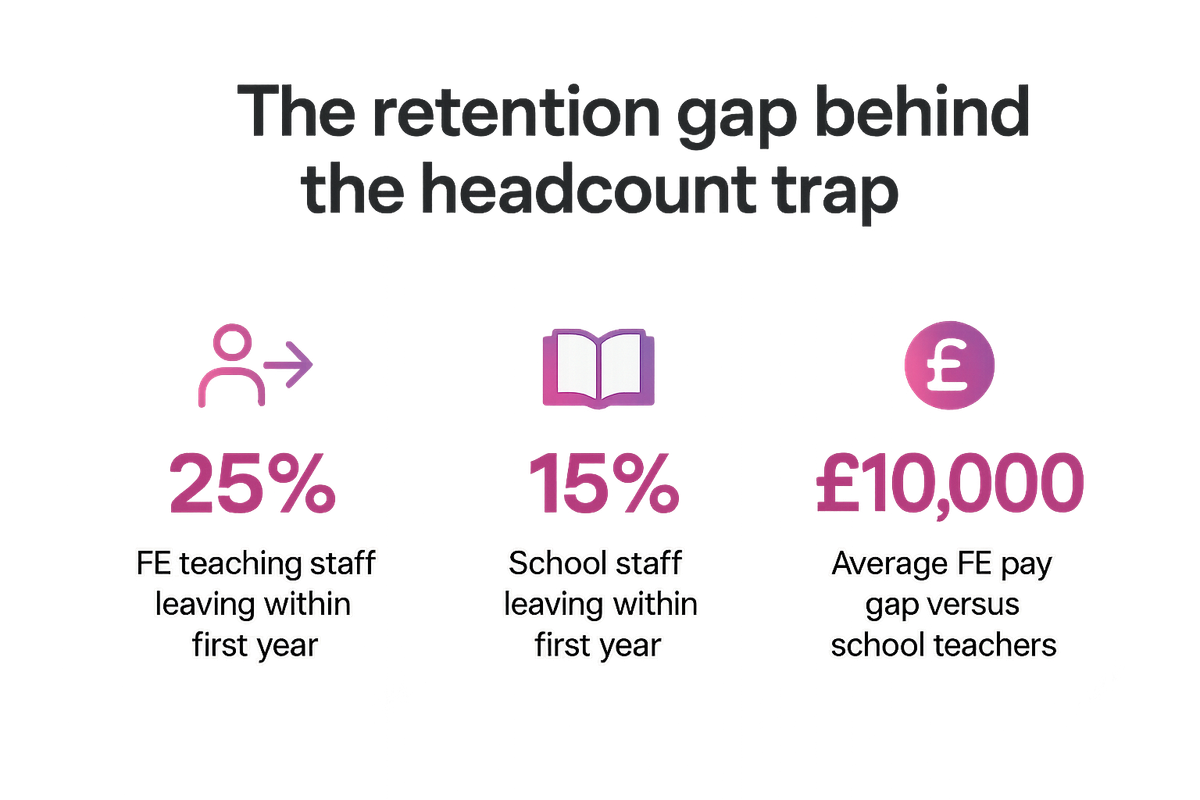
Roughly one in four FE teaching staff leave within their first year, against 15% in schools, and college pay lags school teacher pay by around £10,000 on average (National Audit Office; FE Week). The people you'd lean on for compliance judgement — the ones who know which mapping is current and which assessment last got checked — are scarce, expensive to replace, and structurally likely to move on. When they leave, the process knowledge leaves with them, and you're back to firefighting.
Geography adds a second multiplier most cost models miss. Adult skills funding outside apprenticeships — the Adult Skills Fund, around £1.4 billion in 2025/26 — is largely devolved to local authorities, so a provider operating across regions can face non-standardised local reporting layered on top of national ILR and Ofsted obligations (House of Commons Library). Reporting workload scales with your footprint, not just your learner numbers.
What actually scales
The fix isn't more people doing the same manual mapping faster. It's making the evidence-gathering and re-mapping work repeatable enough that it doesn't depend on any one person's memory.
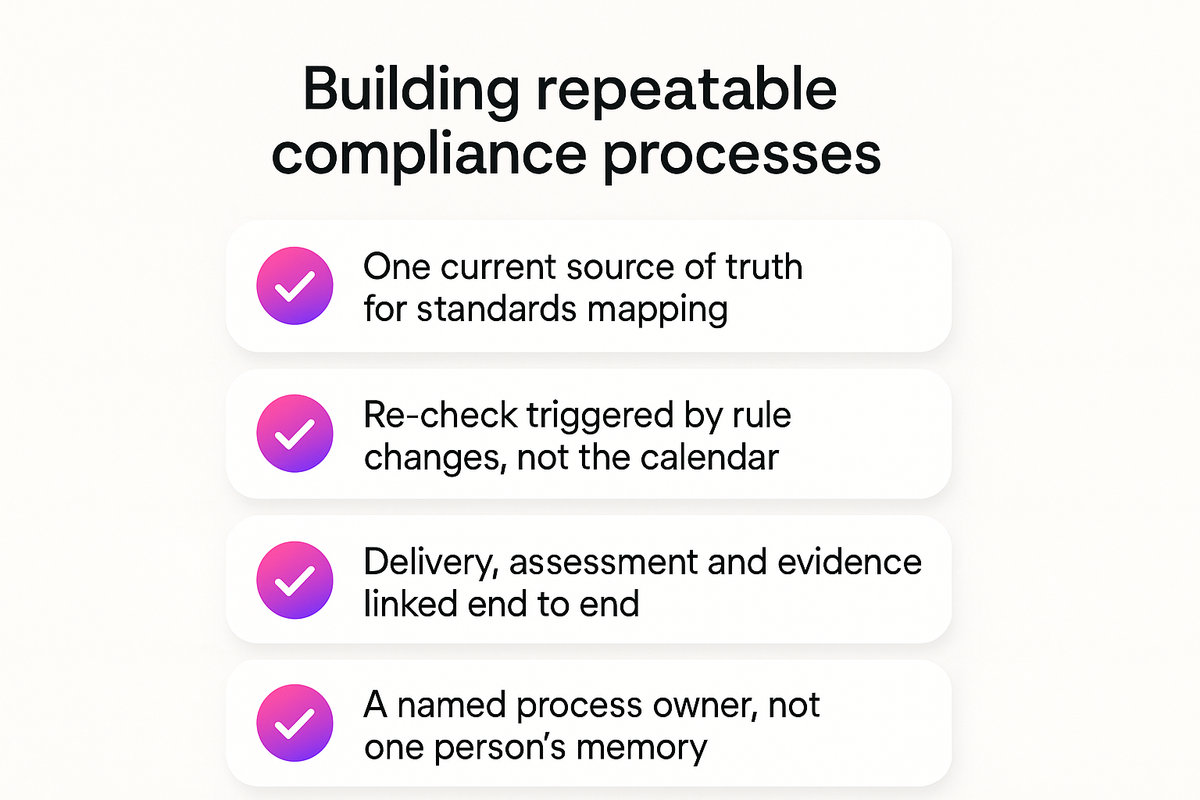
- Keep one current source of truth for how delivery maps to standards and qualification criteria, not a set of spreadsheets that drift apart.
- Trigger re-checks when a rule changes, not on an annual review calendar that's always behind.
- Link what's taught, assessed and evidenced so any Ofsted report card domain or ILR field can be answered on demand, not reconstructed under deadline.
- Treat re-mapping as a defined workflow with an owner and a process, not a task that quietly lives in someone's head until they leave.
Key takeaways
- Ofsted's report card model (live from 10 November 2025) spreads evidence demands across separate graded domains, making readiness continuous rather than periodic.
- The monthly ILR return is funding-critical; small errors can trigger delay, clawback or an assurance review, and most providers manage it through an MIS.
- Apprenticeship rules are being rewritten in real time — duration, assessment model, level 7 eligibility and standard-level funding are all in motion through 2026.
- FE's staff retention gap (roughly 1 in 4 leaving within a year, versus 15% in schools) makes 'hire more compliance staff' an expensive and fragile scaling strategy.
- Providers that build repeatable, systemic re-mapping processes absorb regulatory change; providers relying on a handful of experienced people firefight it.
Our take
The sector treats compliance cost as headcount because headcount is the lever every operations team already knows how to pull. But every one of the shifts above — the report card, the ILR, the apprenticeship rulebook — is a change in what has to be proven, not just how much has to be delivered. That's a process design problem before it's a staffing problem. The providers that come out of this period in good shape won't be the ones with the biggest compliance team; they'll be the ones whose evidence trail updates itself when a rule moves, so their experienced people are spending time on delivery and learner outcomes instead of re-checking last year's mapping against this year's standard.
FAQ
Does Ofsted's new framework actually increase our evidence workload, or just change its shape? Both. The report card assesses leadership, inclusion and safeguarding at whole-provider level and curriculum, teaching, achievement and participation per education provision, so evidence has to be organised and retrievable across multiple domains rather than collated for one inspection visit. Deep dives are being scaled back in favour of ongoing self-reflection, which pushes readiness towards a continuous state rather than a periodic exercise.
How serious are ILR errors, really? The ILR is a monthly return that has to reflect operational activity accurately, including anything that's changed in the past 30 days. It funds the provider directly and feeds national statistics, so administrative errors can trigger funding delay, and any provider can be selected for an assurance review. Most providers manage this through a management information system precisely because manual, disconnected data entry is where errors creep in.
What apprenticeship funding changes should we be planning operations around this year? The minimum duration for new apprenticeship starts dropped to eight months from August 2025, End-Point Assessment is being replaced by a continuous Apprenticeship Assessment model, level 7 apprenticeship funding is restricted from January 2026 to 16–21 year olds (and care-experienced apprentices), and funding for some standards is due to be withdrawn from September 2026. Each of these requires re-checking delivery and assessment materials against the current rules.
Is adding compliance headcount the wrong answer entirely? Not entirely — some growth in capacity is reasonable. The risk is treating headcount as the only lever. FE's retention data shows roughly one in four teaching staff leave within their first year, against 15% in schools, with pay lagging school teachers by around £10,000 on average. That makes experienced compliance judgement scarce and expensive to replace, so a strategy that relies purely on adding people is exposed the moment they move on.