RTO Cost Per Student: The Real Margin Leak in 2025
2 August 2026 · 7 min read
Most CEOs assume their biggest margin leak is discounting to win enrolments or overspending on marketing. The data says otherwise: it's compliance and assessment cost, and the Standards for RTOs 2025 have turned that from a background expense into a line item the board will start asking about directly.
Why this is now your problem, not just your compliance manager's
The Standards for RTOs 2025 commenced on 1 July 2025, replacing the 2015 Standards, and the shift is deliberate: ASQA now wants evidence of demonstrated outcomes in real delivery and assessment contexts, not policy documents sitting in a folder (ASQA, About the Standards).
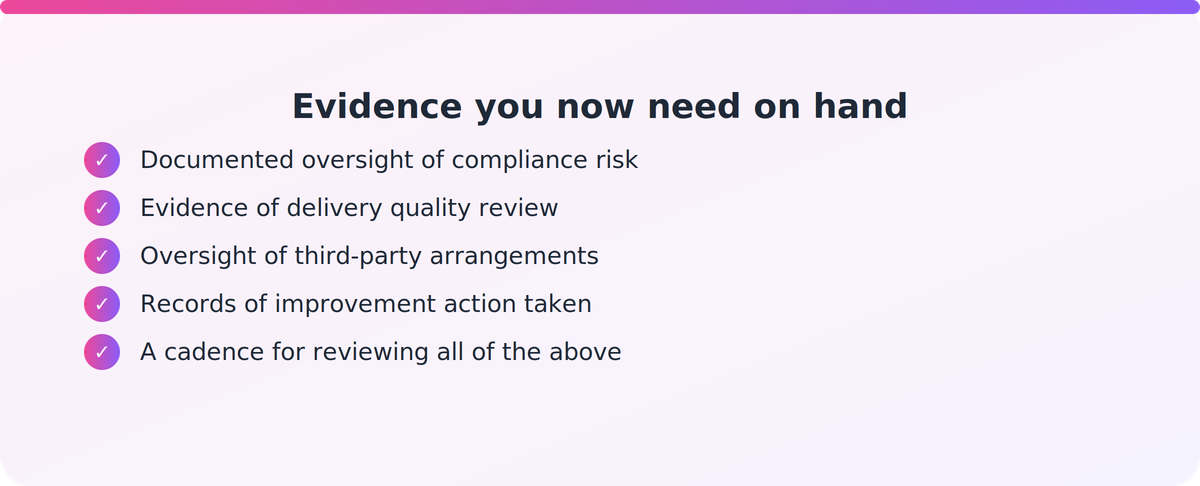
Quality Area 4 makes this personal. It requires the CEO or their delegate to evidence active oversight of compliance risk, delivery quality, third-party arrangements and improvement action. That's not a task you can fully hand off. If your assessor validation process is weak, or your RPL evidence is thin, the Standards now expect you — by name, effectively — to have known and acted on it.
That matters because ASQA's own readiness survey found something worth sitting with: motivation to support the new Standards scored 4.6 out of 5 across the sector, but preparedness scored only 4.0. That 0.6 gap is where audit findings live, and it's a gap most providers haven't closed.
The margin gap hiding in plain sight
Sector revenue hit $13.3 billion in 2025, up 3.5% year-on-year — the sector is growing. But growth and margin aren't the same thing, and the split between provider types is instructive. Domestic RTOs typically run net margins of 20–40%. CRICOS providers are compressed to around 10%, a gap industry analysts attribute largely to higher compliance costs and rising agent fees (Infinity Business Brokers, 2025 RTO State of the Market Report).
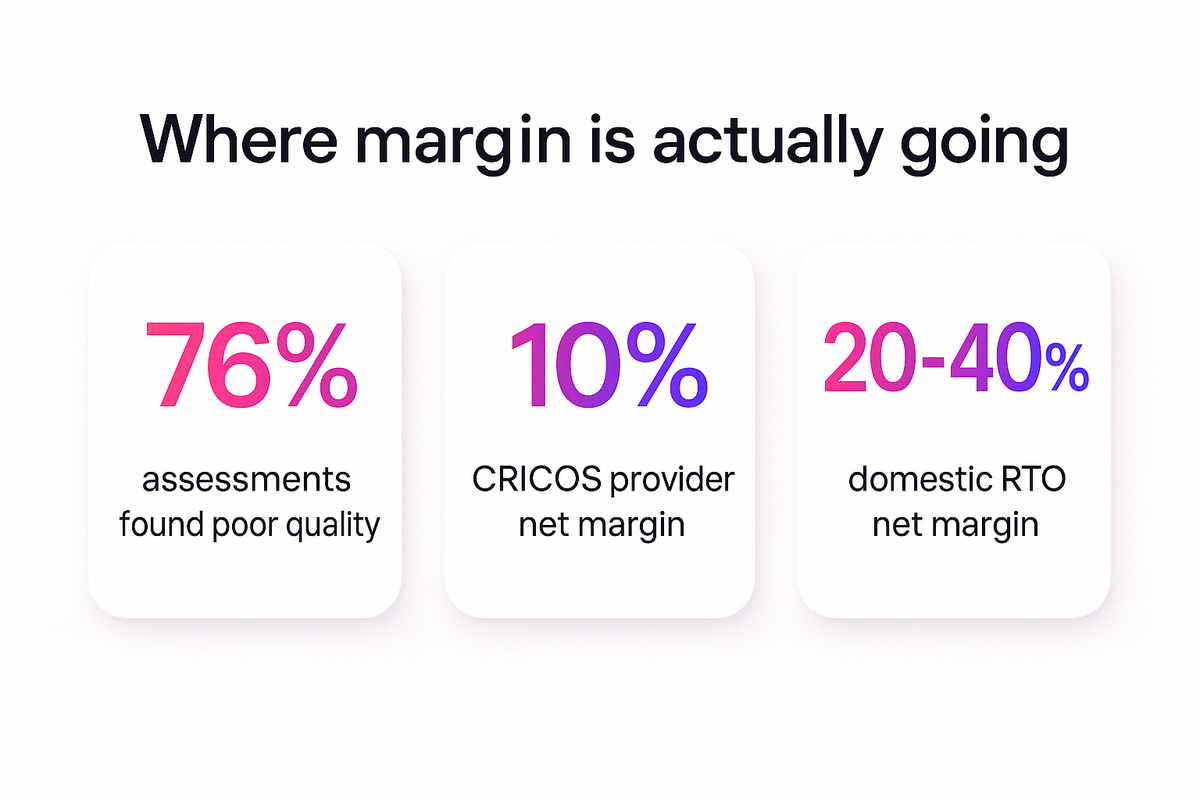
That's not a footnote. It's evidence that compliance overhead now behaves like a variable cost, not a fixed back-office line — it scales with how exposed your assessment and validation practice actually is, and it shows up directly in your P&L relative to peers.
Assessment quality is the audit failure point that actually costs you
At ASQA's March 2026 sector workshop, 76% of assessments reviewed were found to be of poor quality — consistent with prior years, not a one-off. The recurring failure points aren't obscure: unjustified compressed course durations, inadequate validation, RPL granted without sufficient evidence, incomplete trainer and assessor credential files, and governance records that don't match what's actually happening on the floor.
The scale of enforcement now backing this up should reframe how you think about risk. ASQA reportedly has 212 serious matters under investigation, has issued more than 36,000 notices of intent to cancel qualifications since late 2025, and has already executed over 33,000 of those cancellations. Cumulative reporting puts cancelled qualifications and statements of attainment linked to deregistered RTOs above 45,000. Passing an audit in the past is no longer evidence of anything — practice is what gets tested now, continuously.
What Quality Area 4 now asks of you personally
ASQA has also moved to risk-based, intelligence-led regulation — drawing on data trends, complaints and compliance history to decide what to sample. There's no discrete audit window to prepare for anymore. You're effectively always under review, which is exactly why reactive, key-person-dependent compliance processes are now a genuine margin risk, not just an operational annoyance.
AI governance has landed on the compliance agenda, whether you asked for it or not
ASQA has published five Principles for the Responsible Use of AI in VET and run sector workshops specifically on AI compliance under the 2025 Standards. Industry compliance advisers are increasingly arguing AI governance belongs inside core quality and compliance frameworks, not left to IT. If your organisation is using AI anywhere in assessment design, marking support, or learner interaction, that now sits inside your Quality Area 4 oversight obligation — another thing you're expected to be able to evidence, not just permit.
Workforce pressure compounds the cost equation
Australian Industry Group research found around half of surveyed employers would reduce apprentice and trainee employment without financial incentives, and 2026 incentive settings have become more targeted and complex. For RTOs relying on trainer and assessor capacity that's partly funded by employer participation in apprenticeships, that's a second cost pressure sitting on top of compliance overhead — and it's one that hits delivery capacity, not just administration.
Key takeaways
- Compliance and assessment cost is now a margin variable, evidenced by the gap between domestic RTO margins (20–40%) and CRICOS margins (around 10%), where compliance overhead is a cited driver.
- Quality Area 4 of the Standards for RTOs 2025 requires the CEO or delegate to personally evidence oversight of compliance risk, delivery quality, third-party arrangements and improvement action.
- Assessment quality remains the sector's weak point — 76% of reviewed assessments were found poor at ASQA's March 2026 workshop, consistent with prior years.
- ASQA's risk-based, intelligence-led regulation means audit exposure is continuous, not event-based — reactive compliance processes now carry ongoing risk.
- AI governance under the Standards sits inside core compliance oversight, not IT, and needs the same evidenced-practice discipline as assessment and validation.
Our take
The instinct to treat compliance as a fixed cost of doing business is understandable — it's how the sector has budgeted for a decade. But the 2025 Standards and ASQA's own enforcement data make clear that assessment and validation quality is now a live driver of both audit outcome and margin, not a sunk cost you manage once a year before an audit. The providers protecting margin through this shift won't be the ones with the thickest policy manuals. They'll be the ones who can show, on any given week, that assessment practice matches what's on paper — because that's now the actual test.
Where this points, practically, is toward continuous evidence rather than periodic preparation: dashboards over folders, ongoing validation over annual reviews, and oversight that doesn't rely on one person's memory of what happened last audit cycle. Some of that is process discipline. Increasingly, some of it is where AI-assisted tools for coaching assessors and generating evidenced practice fit into the picture — worth understanding on its own terms, separate from any vendor's pitch.
FAQ
Does the Standards for RTOs 2025 change what I personally have to evidence as CEO? Yes. Quality Area 4 requires the CEO or their delegate to demonstrate active oversight of compliance risk, delivery quality, third-party arrangements and improvement action — a governance obligation the 2015 Standards didn't specify at this level of personal accountability.
Is compliance cost really linked to margin, or is that a stretch? Sector financial data supports the link directly: CRICOS providers run at roughly 10% net profit against 20–40% for domestic RTOs, with compliance overhead and assessment rework cited by industry analysts as key drivers of that gap (Infinity Business Brokers, 2025 RTO State of the Market Report).
How does ASQA's risk-based regulation change my audit exposure? ASQA now draws on data trends, complaints and compliance history to decide what to sample, rather than working through scheduled audit cycles. That means providers are effectively under continuous review, raising the cost of catching assessment or validation problems late.
Do I need an AI policy even if we're not using AI in assessment yet? ASQA has published five Principles for the Responsible Use of AI in VET and run dedicated sector workshops on AI compliance under the 2025 Standards, and this is increasingly treated as part of core quality and compliance governance — worth having a position on before it becomes an audit question.