RTO Compliance Ownership: Why Every Document Lands on You
2 August 2026 · 7 min read

An RTO can have flawless policy manuals and still fail an audit. Since the Standards for RTOs 2025 took effect, ASQA doesn't score you on what's written down — it tests whether real training, assessment and support actually match the paper trail. That reconciliation job has to live somewhere. In most providers, it lives on one desk: yours.
Why this hits your desk
You didn't design the audit model this way, but you're the one it's designed around. Four things converge on the compliance manager specifically, not on trainers, not on the CEO, not on IT.
First, the Annual Declaration on Compliance requires the RTO to attest that its self-assurance processes are effective. It has to be signed by a High Managerial Agent, but the evidence behind that signature — internal audit findings, validation activity, improvement actions — is something you assemble, usually once a year, usually from scratch.
Second, under the outcome-focused, student-journey audit approach, auditors spend more time watching training and talking to staff and students than reading your policy library. When delivery doesn't match the TAS, or assessment practice drifts from the mapped tools, you're the one judged on the gap — not the trainer who ran the session.
Third, rectification windows are tight, commonly cited as around 20 working days, with roughly three months for a re-registration application. There's no time to go hunting for evidence after a finding lands. You either have it organised before the audit, or you're scrambling during it.
Fourth, ASQA now names six regulatory risk priorities for 2025–26. You're expected to have early-warning visibility across all six before an auditor asks the question — not to discover a gap when they do.
What actually changed on 1 July 2025
The Standards for RTOs 2025 replaced the previous framework and now sit across two separate legislative instruments — the Outcome Standards and the Compliance Standards, the latter including the Fit and Proper Person Requirements. That's not a cosmetic reshuffle. It means your existing policies, procedures and evidence structures need to be re-mapped against a different architecture, not just relabelled.
ASQA's Practice Guides for the revised Standards are deliberately non-prescriptive. They offer examples and self-assurance questions rather than checklists, which means less busywork ticking boxes — but more interpretation, and more judgement calls you need to be able to defend on the day.
The reconciliation job nobody assigned
Industry commentary on the new audit approach makes an important point: when documentation and practice diverge, auditors treat the practice as the truth and the policy as evidence the RTO knew what good practice looked like but didn't follow through. That's a much harder finding to argue against than a missing document. A missing document is a paperwork gap. A practice gap says your quality system isn't actually running the way you told the regulator it does.
This is why the most common ASQA findings continue to cluster around assessment tools, trainer and assessor requirements, training and assessment strategies, and record management. These aren't set-and-forget artefacts. They need continuous evidence of currency, not an annual once-over before the audit notice arrives.
The reconciliation cycle in practice
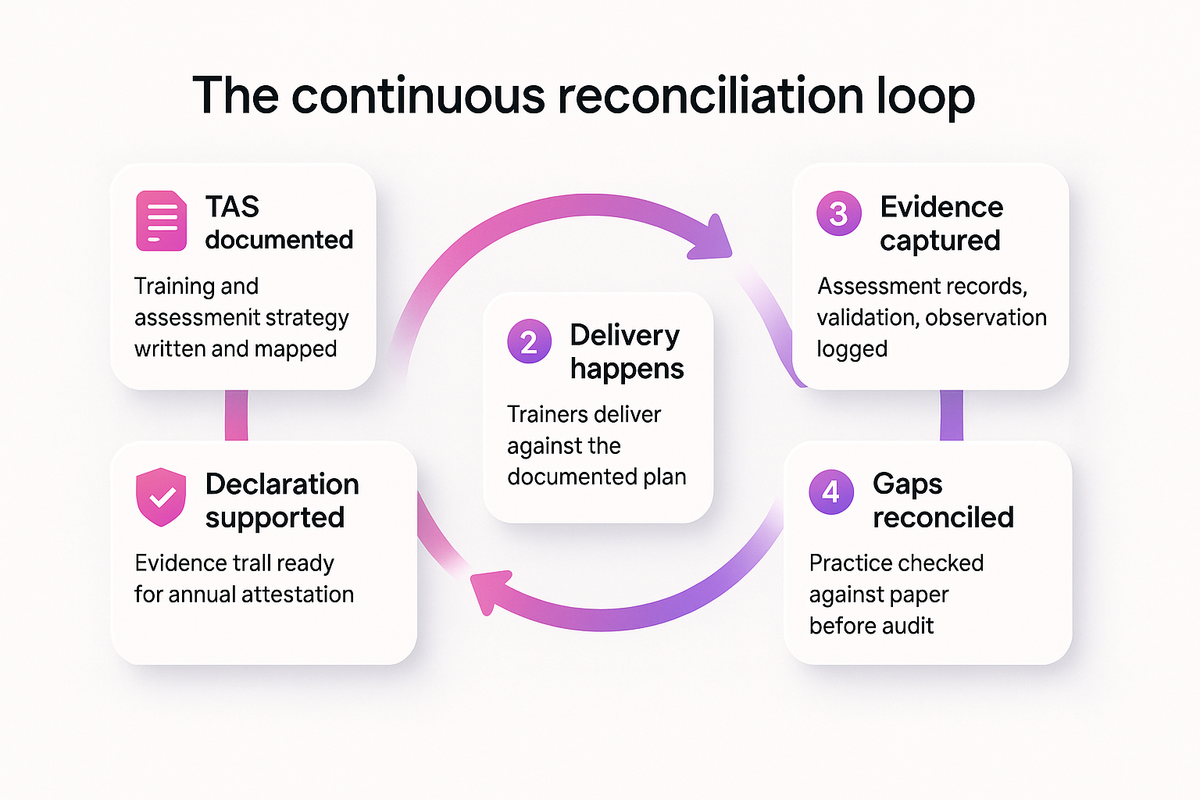
The work looks something like this on a continuous loop, not a once-a-year project:
The annual declaration is a mirror, not a formality
Treat the Annual Declaration on Compliance as a diagnostic, not a sign-off exercise. If you're scrambling to find internal audit records, validation outcomes or improvement actions in the weeks before it's due, that's the clearest signal you have that evidence isn't being captured as it happens — it's being reconstructed after the fact. The declaration doesn't create that risk. It just exposes whether your self-assurance processes were real all year or only real in the week before the deadline.
Six risk priorities, one set of eyes
ASQA's 2025–26 regulatory risk priorities give you a named list of where scrutiny is sharpest: shortened course duration, student work placement, non-genuine providers, recognition of prior learning, academic integrity, and marketing, recruitment and delivery to international students. Each is a specific area where an evidence gap is now more likely to be tested directly, rather than surfaced incidentally.
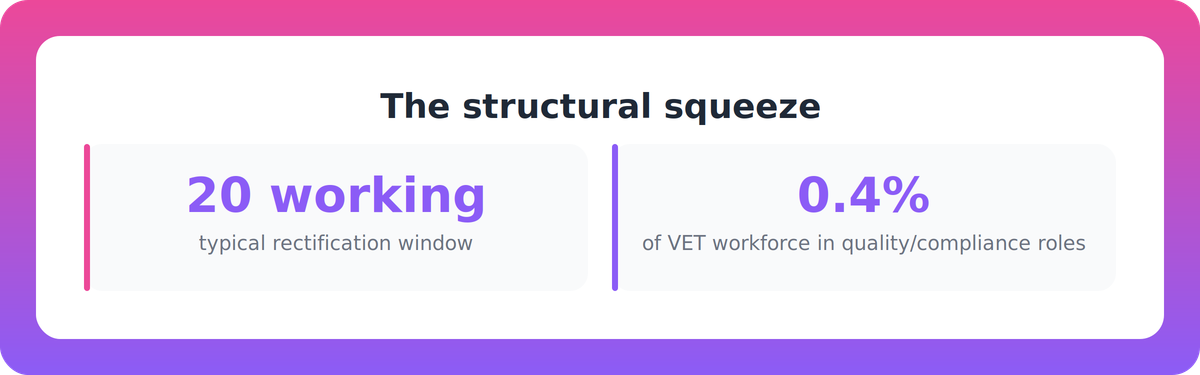
The honest challenge is that most compliance functions are thin. Jobs and Skills Australia's 2024 VET Workforce Study found quality assurance and compliance made up just 0.4 percent of the classified VET workforce — the smallest of six segments studied, and the study itself flags this figure as likely undercounted, since compliance work is often absorbed into leadership, admin and operations roles rather than sitting in a dedicated position. If that's your reality, expecting yourself to hold six live risk areas in your head alongside everything else isn't a resourcing gap you created. It's the structural condition of the role right now.
Key takeaways
- The Standards for RTOs 2025 now sit across two legislative instruments — the Outcome Standards and the Compliance Standards, including the Fit and Proper Person Requirements — so existing evidence structures need re-mapping, not relabelling.
- ASQA's audit approach has shifted toward observing delivery and interviewing staff and students; when practice and paperwork diverge, auditors treat the practice as the true position.
- Rectification windows of around 20 working days leave no time to locate evidence after a finding — it needs to be organised before the audit, not during it.
- The Annual Declaration on Compliance is a useful early-warning test: if assembling the evidence behind it is a scramble, your self-assurance processes aren't running continuously.
- ASQA's six 2025–26 risk priorities — shortened course duration, work placement, non-genuine providers, RPL, academic integrity, and international marketing/delivery — deserve standing, not annual, visibility.
Our take
The structural problem here isn't that ASQA raised the bar — arguably the shift toward practice-based evidence is a fairer test of a genuinely functioning RTO than a policy library ever was. The problem is that the job of reconciling paper and practice has been handed to one role, often thinly resourced, with no clear system for capturing evidence as it happens rather than reconstructing it under deadline pressure. Until that reconciliation work is distributed and made continuous — logged as delivery happens, not backfilled before an audit or declaration — the compliance manager will keep being the single point where every gap, however small, eventually surfaces.
FAQ
What changed structurally in the Standards for RTOs 2025? The 2025 Standards, effective 1 July 2025, moved from a single combined framework to two legislative instruments — the Outcome Standards and the Compliance Standards, which include the Fit and Proper Person Requirements. RTOs need to map existing policies and evidence against this new structure rather than simply update wording.
Why do ASQA audits feel different now compared to a few years ago? Industry commentary describes a shift toward outcome-focused, student-journey auditing, where auditors spend more time observing training and talking with staff and students than reading policy manuals. When what's documented doesn't match what's actually delivered, the practice is treated as the true position.
How much time do we actually have to fix a finding? Rectification windows are commonly cited as around 20 working days, with an application period of roughly three months for re-registration. That leaves little room to hunt for evidence once a non-compliance is raised, which is why evidence needs to be locatable before the audit starts.
What should we watch most closely under the 2025–26 risk priorities? ASQA has named six regulatory risk priorities for 2025–26: shortened course duration, student work placement, non-genuine providers, recognition of prior learning, academic integrity, and marketing, recruitment and delivery to international students. Each is an area worth having standing, not annual, visibility over.