Why the RTO Compliance Manager Workload Just Got Personal
2 August 2026 · 6 min read

ASQA's 2025 Standards didn't just add new clauses — they changed what "compliant" means. The regulator no longer wants proof a document exists; it wants proof your systems catch problems before an auditor finds them first. That shift lands on one desk: yours. It turns the pain points you already carry — scattered evidence, unclear ownership, no early warning — into the exact things ASQA's self-assurance model is now designed to test.
Why This Lands on Your Desk
Under the Standards for RTOs 2025, which commenced 1 July 2025, the "fit and proper person" declaration extends to all High Managerial Agents, not just the CEO or the board (ASQA). If you own the compliance system, you're named. That's a quiet but significant shift — from "the RTO failed to produce evidence" to "you failed to produce it", personally.
The stakes behind that are not abstract. Penalties for providing false or misleading information to ASQA have risen to $66,600 for individuals and $333,000 for bodies corporate under the NVETR Act. Meanwhile, ASQA's risk-based model explicitly rewards providers who can show continuous, demonstrable self-assurance and penalises those who rely on a scramble of evidence gathered only when an audit is announced. The annual pre-audit scramble you've always treated as an internal inconvenience is now, structurally, a risk signal the regulator reads.
From "Show Me the Document" to "Show Me the System Works"
This didn't happen overnight. It traces back to the 2020 Rapid Review of ASQA, whose 24 recommendations — all supported by government — pushed the regulator toward provider self-assessment, early identification of non-compliance, and structured rectification timeframes. The Standards for RTOs 2025 are that philosophy fully embedded: legislated Outcome Standards, separate Compliance Requirements, and a standalone Credential Policy governing trainer, assessor and validator qualifications (DEWR; ASQA).
The practical consequence is that audits now assess whether your systems demonstrably produce quality outcomes, industry relevance and continuous improvement — not just whether a folder of evidence exists somewhere. Self-assurance and active risk monitoring are explicit regulatory expectations, not aspirational best practice you get credit for mentioning.
The Numbers Behind the Pressure
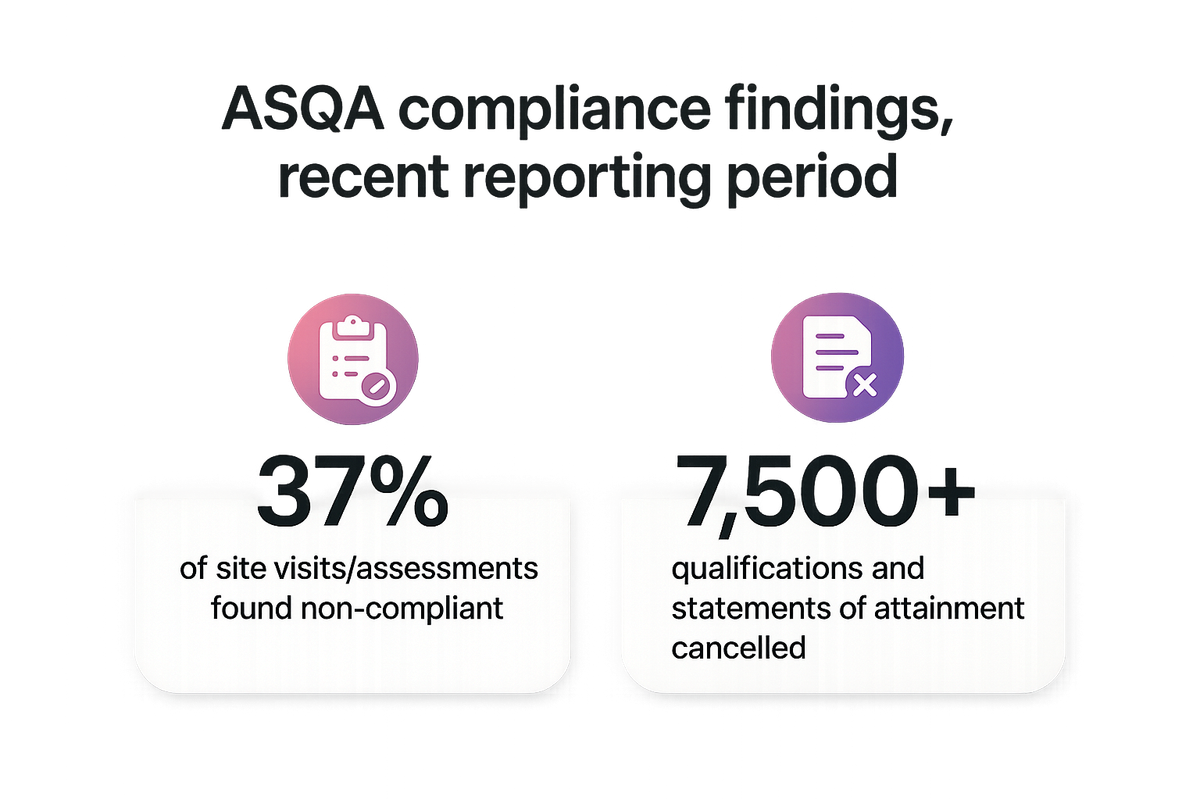
Non-compliance is not a rare event you can plan around as an outlier. In a recent reporting period, 37% of ASQA site visits and performance assessments resulted in a non-compliance finding, and ASQA made decisions to cancel more than 7,500 qualifications and statements of attainment issued by critically non-compliant providers.
The failure points cluster in predictable places: assessment tools, evidence of trainer and assessor currency, and Training and Assessment Strategies (TAS). These are precisely the artefacts most likely to be scattered across shared drives, personal inboxes and individual staff members' hard drives — which means traceability isn't a workflow nicety anymore. It's a direct audit-outcome variable, and under the fit and proper person declaration, it's your variable.
Why Point-in-Time Readiness No Longer Works
ASQA runs a genuinely risk-based model: providers with a solid compliance history attract lighter-touch scrutiny, while those with weaker records face closer review through desk audits, targeted reviews or full site audits. That's the upside — sustained, demonstrable readiness can reduce audit intensity over time.
The catch is that ASQA reviews and adjusts its regulatory risk priorities annually, through a formal environmental scan. Sector commentary on the 2025–26 priorities describes six risks defined with more nuance and less tolerance for volume- or paper-based compliance than in prior years. If your evidence base and interpretation of the Standards were last refreshed for the previous audit cycle, you are, by definition, working from a stale risk map.
The Ownership Problem Nobody Names
Here's the part that rarely gets said plainly: being the single point where evidence, ownership and risk visibility converge isn't a personal failing — it's how most RTOs have built the role. But it's also exactly the structure ASQA's self-assurance model is designed to probe. A regulator asking "how do you know your system works" is really asking whether that convergence point can answer confidently, on any given Tuesday, not just in the six weeks before an audit.
Key takeaways
- The Standards for RTOs 2025 shifted ASQA's test from document existence to demonstrated system performance — self-assurance and risk monitoring are now explicit requirements, not best practice.
- The "fit and proper person" declaration applies to all High Managerial Agents, extending personal accountability for systemic compliance gaps to compliance managers directly.
- 37% of recent ASQA site visits and performance assessments produced a non-compliance finding, concentrated in assessment tools, trainer/assessor currency and TAS — the artefacts most often scattered across drives and inboxes.
- ASQA's risk priorities are reviewed annually, so interpretation guidance and audit focus areas shift every year; point-in-time readiness is structurally behind the regulator's current settings.
- Continuous, traceable evidence with clear ownership reduces audit intensity over time under ASQA's risk-based model — it's a governance investment, not administrative overhead.
Our take
The uncomfortable truth in the 2025 Standards is that they've formalised something most compliance managers already knew: you were never really being judged on paperwork. You were being judged on whether the organisation actually behaves the way its paperwork claims. ASQA has just stopped pretending otherwise, and it's put a name and a legal declaration next to the person who has to answer for it.
That doesn't mean the job gets impossible — it means the job gets honest. The RTOs that will find this easiest aren't the ones with the thickest policy folders. They're the ones where ownership of every piece of evidence is unambiguous, where drift against current Standards gets noticed in weeks rather than at the next audit notice, and where the compliance manager isn't the last line of defence but one visible node in a system that's built to surface its own problems. That's a harder thing to build than a folder structure. It's also the only thing the 2025 Standards are actually asking for.
FAQ
What changed with the Standards for RTOs 2025? They commenced 1 July 2025 and represent the most significant overhaul since 2015, splitting requirements into legislated Outcome Standards, separate Compliance Requirements, and a standalone Credential Policy for trainer, assessor and validator qualifications (DEWR; ASQA).
Does the "fit and proper person" declaration really apply to me, not just the CEO? Yes. Under the current framework it extends to all High Managerial Agents, which includes compliance managers with genuine authority over compliance systems, not only the RTO's chief executive or governing body.
What are ASQA's most common audit failure points? Audit findings cluster around assessment tools, evidence of trainer and assessor currency, and Training and Assessment Strategies (TAS) — the same artefacts most often scattered across individual staff members' drives and inboxes.
How often do ASQA's risk priorities actually change? ASQA reviews and adjusts its regulatory risk priorities annually through a formal environmental scan, meaning the interpretation and focus of audits can shift meaningfully from one year to the next.