The Real Cost of Assessor Workload in NZ PTEs
2 August 2026 · 6 min read

The Real Cost of Assessor Workload in NZ PTEs
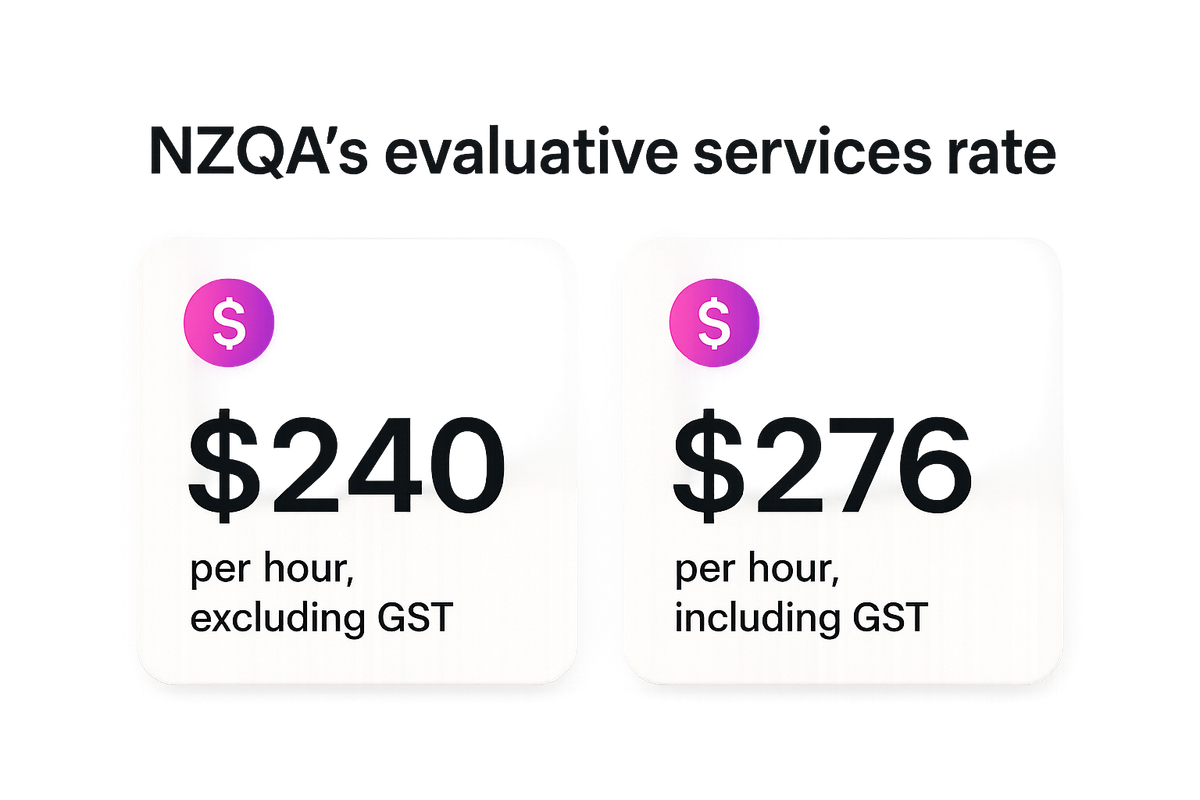
NZQA's own evaluative services rate — $240 an hour excluding GST, $276 including GST — gives providers a regulator-issued yardstick for what assessor and moderation time is actually worth. Applied honestly against internal hours, it turns a vague administrative burden into a real number, right as the Programme Approval, Recognition, and Accreditation Rules 2026 and new Industry Skills Boards reshape compliance workload from 19 January 2026.
What does NZQA's own hourly rate tell PTEs about assessor time?
NZQA publishes a fixed rate for its evaluative services: $240 an hour excluding GST, or $276 including GST, plus travel, contractor fees and disbursements where relevant. This is what the regulator itself charges for the kind of quality assurance work — assessment review, standard alignment checks, moderation-style scrutiny — that PTE assessors do internally every week.
Few providers have ever applied that figure to their own operation. Assessor hours spent drafting, mapping and moderating unit standard and qualification assessments are typically absorbed into a role's general workload rather than costed as a discrete line item. NZQA's rate gives PTEs a legitimate benchmark to change that — multiply hours logged against it, and "admin overhead" becomes a dollar figure a board or funder can actually see.
What's changing under the Programme Approval Rules 2026 — and what isn't?
The Programme Approval, Recognition, and Accreditation Rules 2026 come into force on 19 January 2026 and do genuinely simplify some paperwork:
- Fewer requirements for qualifications built entirely from skill standards.
- Removal of Industry Skills Board endorsement for Type 2 programme changes.
- Removal of the sub-contracting rule.
Separately, NZQA is also moving most PTEs from an annual to a biennial financial return cycle unless it advises otherwise. Taken together, these changes are a real acknowledgement from the regulator that compliance load has been heavy.
What none of this touches is the recurring cycle underneath programme-level paperwork: drafting assessments, mapping them to unit standards and qualifications, and running them through moderation. That work doesn't get lighter just because the approval process around it does.
Why will Industry Skills Boards add another layer of assessment work?
The Tertiary Education Strategy 2025–2030 confirms that new Industry Skills Boards are being established in 2026 to advise on qualifications and programme investment. That's a good thing for keeping qualifications relevant to industry — but it also means PTEs and ITOs should expect further rounds of assessment realignment as industry input feeds back into standards.
So 2026 cuts two ways. Programme-level approval gets simpler. Assessment-level work, driven by fresh ISB input, likely gets busier. A workload audit run before these changes land is the only way to see which effect is larger for a given provider's qualification mix.
Where does the non-teaching time actually go?
One documented NZ example, published via SupaHuman's own material, describes an ITO needing significant staff time simply to assemble a coherent, NZQA-ready audit trail — version control, alignment evidence — ahead of a moderation visit. That's time spent proving the work was done properly, not doing the teaching or assessment work itself.
This sits on top of the qualification path assessors already carry. The New Zealand Certificate in Assessment Practice (Level 4), delivered through Open Polytechnic, is the standard route to becoming a qualified assessor — and it layers ongoing moderation and documentation duties onto assessors who are already juggling qualification-plus-practice obligations.
Sector commentary from within the NZ PTE space argues that spreadsheets, version control and reformatting for NZQA alignment routinely displace teaching and programme development time. It's worth being upfront that these figures are largely vendor-published and directional rather than independently audited — which is exactly why an internal audit, not anecdote, is the credible next step.
Running your own workload audit: where to start
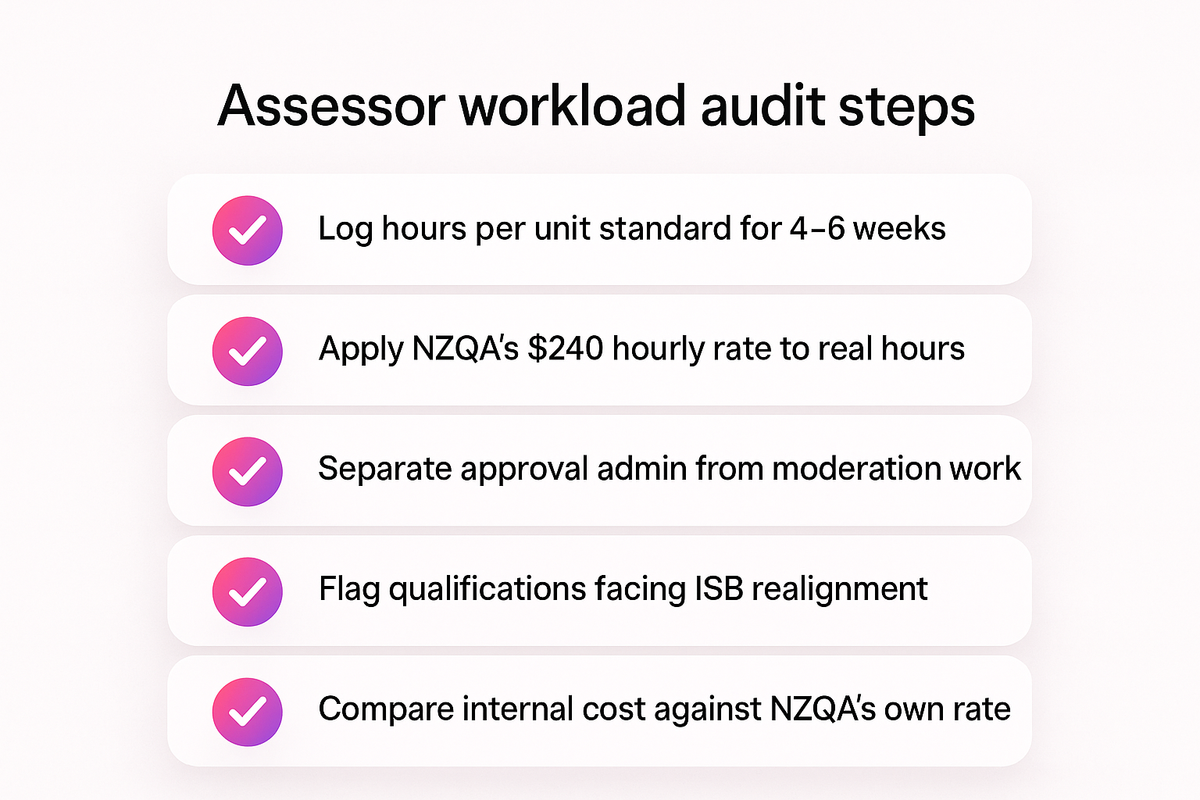
A simple audit doesn't need new software or a consultant. It needs a few weeks of honest time-tracking against NZQA's own benchmark:
- Log hours per unit standard or qualification across drafting, mapping, moderation and evidence assembly for four to six weeks.
- Apply NZQA's $240-an-hour (excl. GST) rate to those hours to get an actual cost figure, not an estimate.
- Separate programme-approval admin — which is easing under the 2026 rules — from ongoing assessment and moderation work, which isn't.
- Flag qualifications likely to face ISB-driven realignment in 2026 and budget assessor time for that ahead of time.
- Compare the cost of internal assessor hours against what NZQA itself would charge for equivalent evaluative work.
Key takeaways
- NZQA's own evaluative services rate — $240 excl. GST, $276 incl. GST — is a ready-made, regulator-issued benchmark PTEs can apply to their own assessor and moderation hours.
- The Programme Approval Rules 2026 (in force 19 January 2026) simplify approval-level paperwork but leave assessment drafting, mapping and moderation largely untouched.
- New Industry Skills Boards, confirmed under the Tertiary Education Strategy 2025–2030, are likely to trigger fresh assessment realignment work from 2026.
- A documented NZ example shows significant non-teaching time going into assembling audit trails for moderation, not into teaching or assessment itself.
- Sector claims about admin load displacing teaching time are largely vendor-published and directional — reason enough for PTEs to run their own workload audit rather than rely on it.
Our take
NZQA handing providers its own hourly rate is a small but useful gift — most PTEs are sitting on a genuine costing tool and not using it. The bigger issue is that 2026 brings simplification and complexity in the same rule set: easier programme approval, but a fresh wave of ISB-driven assessment realignment layered on top. Providers who treat this as a net win without auditing their own assessor hours first are likely to be surprised by where the time actually goes.
FAQ
What is NZQA's hourly rate for evaluative services, and why does it matter to PTEs? NZQA charges $240 an hour excluding GST ($276 including GST), plus travel, contractor fees and disbursements, for its evaluative services. It gives PTEs a regulator-sanctioned figure to cost their own internal assessor and moderation hours, rather than treating that time as unmeasured overhead.
When do the Programme Approval, Recognition, and Accreditation Rules 2026 take effect? They come into force on 19 January 2026, reducing some administrative steps — including fewer requirements for qualifications built entirely from skill standards and removal of the sub-contracting rule — but leaving the core cycle of assessment drafting, mapping and moderation unchanged.
How will Industry Skills Boards affect assessment work for PTEs and ITOs? The Tertiary Education Strategy 2025–2030 confirms new Industry Skills Boards being established in 2026 to advise on qualifications and programme investment. As industry input feeds into standards, PTEs and ITOs should expect further rounds of assessment evidence and mapping realignment.
Is the annual financial return changing for PTEs? Yes. NZQA's wider 2026 rule changes move most PTEs from an annual to a biennial financial return cycle, unless NZQA advises otherwise for a specific provider.
What qualification do NZ assessors need, and does it add to their workload? Most assessors work towards the New Zealand Certificate in Assessment Practice (Level 4), delivered through Open Polytechnic. That qualification sits alongside — not instead of — the ongoing moderation and documentation duties assessors carry day to day.