Cost Per Student in NZ Vocational Training: CEO Guide
22 October 2026 · 7 min read
You can probably quote revenue per enrolment to the dollar. You probably can't quote what it costs to take one student from enquiry to completion. In 2026 that gap matters more, because the rules shaping those costs are being rewritten and no published NZ benchmark exists to tell you what normal looks like.
Why this lands on your desk
You own the P&L and answer to the board for margin. Yet the research behind this piece found no published benchmark for cost per enrolled student, or for operating margin, across NZ PTEs. There is no external yardstick. Your own internal number is the only reference point you will get.
Meanwhile the ground is moving on several fronts at once:
- The PTE Rules 2026 came into force on 19 January 2026. They replace the PTE Registration Rules 2025 and the PTE Enrolment and Academic Records Rules 2022, and remove the annual fee. Non-funded PTEs now provide financial returns biennially unless NZQA notifies them otherwise.
- External evaluation and review (EER) is being removed. The PTE Rules and the Programme Approval, Recognition and Accreditation Rules 2026 reflect that, and the sub-contracting rule moves into the new Quality Assurance of Tertiary Education Providers Rules.
- Te Pūkenga is being disestablished. The legislation passed in October 2025 and took effect on 1 January 2026. Ten regionally governed polytechnics are being re-established initially, and eight Industry Skills Boards (ISBs) now lead standard-setting and qualification development.
Each change moves cost from one place to another. That cost lands in the margin you are judged on.
Why the number hides in plain sight
Cost per student is rarely one line in your accounts. It is scattered.
Marketing carries the enquiry cost. Admissions carries enrolment and records. Tutors carry delivery, but also assessment, moderation and evidence-gathering that never shows as a separate budget line. Your compliance manager carries reporting, self-review prep and audit readiness. Student support carries retention. Some of this sits in salaries, some in contractors, and some in the unrecorded evenings of one senior person.
That last category is the dangerous one. If the true cost of compliance is a single experienced person's goodwill, it looks cheap until they leave. It then becomes expensive overnight.
Also note the denominator. Cost per *enrolled* student flatters you. Cost per *completed* student tells the truth, because every withdrawal has already consumed enquiry, enrolment and early delivery cost.
What the 2026 changes do to your cost lines
Be honest about what is known and what is not.
Known and modest. Removing the annual fee and moving non-funded PTEs to biennial financial returns is a small compliance saving. NZQA has not published any cost-per-student impact, so don't assume the saving is material.
Known in direction, unknown in size. ISBs handle qualification and standards development, moderation and consent requirements, and endorsement of providers' vocational programmes. The question is not what EER is called now. It is what replaces it in cost and effort terms.
Genuinely unknown. The Food and Fibre ISB's predecessor body said ISBs have lower government funding and will likely charge providers for some quality assurance functions. No fee schedule has been published. Flag it as an unknown line in your model. Don't invent a figure to make the spreadsheet feel complete.
One to verify. A secondary source, a training provider's blog, reports that annual organisation self-review will be required of non-university providers from July 2026. It also reports that NZQA consulted on Highly effective, Effective and Not effective descriptors, with consultation reportedly closing on 7 September 2026 and no final decisions announced. We could not verify this on an NZQA page. Confirm it with NZQA before it goes into a budget.
Sector instability is a cost too
The Spinoff, citing Official Information Act documents, reported that Te Pūkenga lost over $80m in funding and one in 10 staff ahead of the split. The Minister also told the select committee that disestablishment "will not be completely equitable", with less solvent polytechnics more likely to be merged or federated (RNZ).
For you, that means a shifting talent pool, shifting competitors and a shifting pipeline. Work-based learning divisions are moving to new or existing PTEs, polytechnics and wānanga, and ISBs cannot enrol, manage or assess learners after 31 December 2027. TEC says funding arrangements may fall outside normal investment round timing. Your enrolment forecast and your cost base both carry more uncertainty than usual.
Build your own fully loaded number this quarter
You don't need a consultant or a new system. You need a few weeks of honest accounting.
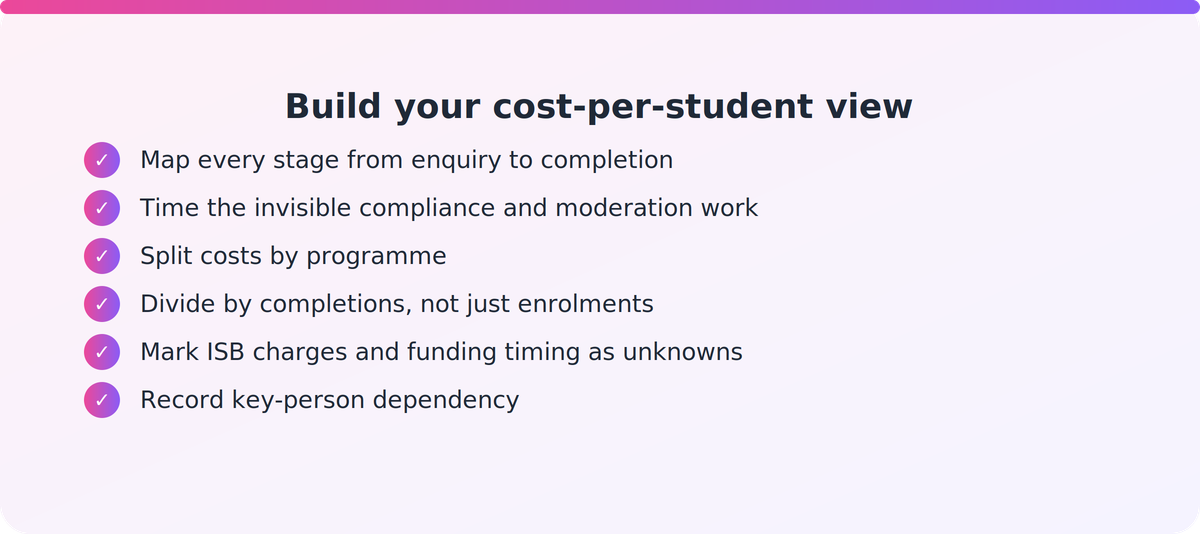
- Map the journey. List every stage from enquiry to completion, and who touches the student at each one.
- Time the invisible work. Ask each team how many hours a month go on compliance, moderation, reporting and records. Include the person everyone relies on.
- Split by programme. A programme with heavy moderation and evidence needs costs more to run than one without. Your average hides that.
- Divide by completions as well as enrolments. The gap between the two numbers is your attrition cost.
- Mark the unknowns. ISB quality assurance charges and funding timing go in as open lines with a range of scenarios, not guesses.
- Record key-person dependency. Note which cost lines would double if one named person left.
Where AI fits, and where it doesn't
NZQA's material on academic integrity and AI is guidance that encourages providers to work with staff, learners and NZQA. It is not a binding rule. We found no regulator statement on AI in back-office compliance, enrolment or reporting.
So the question isn't whether you are permitted to use it. It is whether a given tool lowers a cost line you have actually measured, and protects quality while doing so. Keep assessment integrity firmly in view. Without your own cost-per-student number, you cannot answer that question for any tool, AI or otherwise.
Our take
Most technology decisions in PTEs start with a product and work backwards to a problem. In a year of regulatory reshuffling, flip that. The CEOs who come out stronger will be the ones who know what a completed student costs them, line by line, before the new charges, rules and funding timings arrive.
A benchmark may eventually appear. Don't wait for it. A rough, honest internal number beats a precise industry average you don't have.
Key takeaways
- No published NZ benchmark for cost per enrolled student exists, so your internal figure is your only reference point.
- The PTE Rules 2026 (in force 19 January 2026) bring a modest compliance saving, but NZQA has published no cost-per-student impact.
- ISB quality assurance charges are likely but unpriced. Treat them as an open line, not an estimate.
- Cost per completed student exposes attrition cost that cost per enrolled student hides.
- NZQA's AI material is guidance, not a binding rule. Judge any tool on measured cost and quality, not permission.
FAQ
Is there an NZ benchmark for cost per student in vocational training?
Not that we found. The research located no published benchmark for cost per enrolled student or operating margin for NZ PTEs, and NZQA has published no cost-per-student impact for the 2026 rule changes. Build an internal figure.
What changed for PTEs under the PTE Rules 2026?
The rules came into force on 19 January 2026. They replace the PTE Registration Rules 2025 and the PTE Enrolment and Academic Records Rules 2022 and remove the annual fee. Non-funded PTEs now provide financial returns biennially unless NZQA notifies them otherwise.
Will ISBs charge PTEs for quality assurance?
Likely for some functions, according to the Food and Fibre ISB's predecessor body, which said ISBs have lower government funding. No fee schedule has been published, so the cost cannot yet be modelled reliably.
Does NZQA allow PTEs to use AI?
NZQA's material on academic integrity and AI is guidance encouraging providers to work with staff, learners and NZQA. It is not a binding rule, and no regulator statement on AI in back-office compliance, enrolment or reporting was found. Keep assessment integrity in view.
A first step for this week: ask your compliance lead how many hours a month they spend, and what would stop if they were away for a fortnight. That answer is the start of your number.