The Compliance Tax: Cost Per Learner Under Regulatory Churn
2 August 2026 · 7 min read

Regulatory change in UK vocational education used to arrive as a project: a new framework, a period of adjustment, then a new steady state. That model has broken down. Ofsted, funding oversight and apprenticeship policy have all moved at once, and the cost of keeping up now sits inside your cost per learner every single term, not as a one-off line in a transition budget.
Why this hits your desk
You don't get to delegate this one. Three things landed on you specifically in 2025, not on your curriculum team or your MIS manager.
First, the DfE's Financial Handbook for independent training providers is now reissued annually — the 2025 edition took effect from 1 August 2025, and a further edition for 1 August 2026 has already been published. Compliance with it is a condition of funding, and it requires you to maintain a funding compliance scrutiny function, a risk register and a business continuity policy. That's not a document you file once. It's a recurring obligation you have to resource and defend to your board every year.
Second, Ofsted's renewed inspection framework, live for FE and skills from 10 November 2025, drops the old single headline grade in favour of an 11-area report card graded on a five-point scale from Exceptional to Urgent improvement, with safeguarding assessed separately as met or not met. "Deep dive" inspections are being retired in favour of evidence inspectors have described as needing to be lived, not laminated. In practice, that means always-on inspection readiness, not periodic preparation before a known visit window — a resourcing decision only you can make.
Third, and this is the one boards rarely see coming: failure to submit accounts for assessment when requested automatically triggers an inadequate rating, with the DfE entitled to take further action at its discretion. That's a direct line from back-office capacity to your regulatory standing and your funding continuity — the exact metric you answer for.
The year the furniture moved
It's worth naming how much institutional structure shifted underneath providers in a matter of months. The ESFA closed on 31 March 2025, its functions absorbed into the Department for Education. IfATE closed on 1 June 2025, with its functions transferring to the newly established Skills England — and reports since suggest business-as-usual activity at Skills England has slowed, delaying reviews and the creation of some apprenticeship standards. If you've been waiting on a standard revision to plan next year's delivery, that delay is now your problem, not theirs.
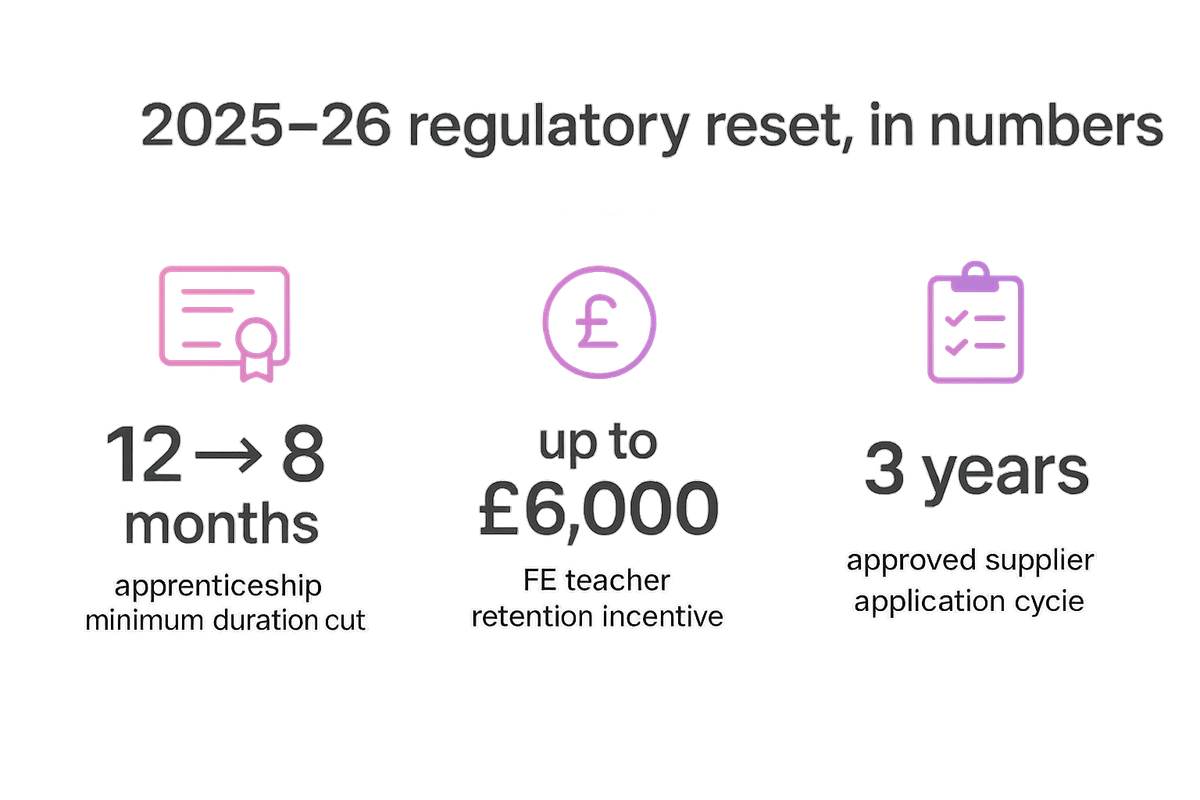
Layer on the apprenticeship reforms rolling through in parallel: minimum apprenticeship duration cut from 12 to 8 months from August 2025; off-the-job training requirements set per standard rather than a flat 20%; English and maths made optional for apprentices aged 19 and over; and End-Point Assessment being replaced by an "Apprenticeship Assessment" delivered throughout the programme, phased in between 2025 and 2027. That last change means you'll be running old and new assessment models side by side for some standards — dual-running that has to be tracked, not assumed away.
From January 2026, level 7 apprenticeship funding narrows to new apprentices aged 16–21, with an exception for care-experienced apprentices. If level 7 delivery is part of your programme mix, that's a revenue line to reforecast now, not after the funding change lands.
And the funding mechanism itself has changed shape: the Apprenticeship Levy has been replaced by the Growth and Skills Levy, a broader mechanism spanning apprenticeship and non-apprenticeship programmes — a structural shift in how employer contributions convert into your revenue.
Why your compliance team can't just absorb this
Every one of those changes ripples into curriculum, assessment materials and the evidence you have to hold. That work has, until now, run through a small number of experienced compliance and curriculum staff doing manual re-mapping each time a standard, framework or funding rule moves. When that group is three or four people, your audit outcomes and your funding standing depend on those specific individuals staying current and staying employed. That's key-person risk in its purest form, and it caps how fast you can grow, because every new programme or campus adds to the same bottleneck.
The sector's own workforce data makes this worse before it makes it better. The Education Select Committee's 2025 inquiry flagged an unresolved FE recruitment and retention crisis, citing pay disparities, workload and job insecurity — prompting a targeted retention incentive of up to £6,000 for FE teachers in priority subject areas, even as adult education funding for 2025–26 has been reduced. Retention incentives help with teaching staff; they don't touch the compliance specialists holding your regulatory evidence together.
Competitive position now runs through clean compliance, not new entrants
Here's the part boards often miss. New FE provider entry is now explicitly restricted, justified only through a three-yearly approved supplier application process — the latest round concluded in summer 2025 for delivery years 2026 to 2029, against a backdrop of stated sustained financial constraints and pressure on system resources. Fewer new entrants means your competitive position increasingly rests on maintaining clean regulatory standing rather than fending off market dilution. Getting compliance right internally isn't defensive anymore — it's close to your main lever for market share.
Key takeaways
- The Financial Handbook's annual reissue (2025 edition from 1 August 2025, 2026 edition already published) makes compliance a recurring budget line, not a one-off project.
- Ofsted's 10 November 2025 framework demands always-on evidence readiness across 11 report-card areas, not periodic prep for scheduled deep dives.
- ESFA and IfATE closures (31 March and 1 June 2025 respectively) mean standards guidance and funding rules now route through DfE and Skills England — with reported delays at Skills England already affecting standard revisions.
- Apprenticeship reform (duration, off-the-job rules, EPA replacement, level 7 defunding from January 2026) is multi-year and phased, creating a period of dual-running rules your team has to track simultaneously.
- Restricted FE market entry via the three-yearly approved supplier process shifts competitive advantage toward clean compliance standing, not fewer competitors.
Our take
Most providers are still costing regulatory change as a series of projects: a push before an Ofsted visit, a scramble when a standard revises, a scurry each August when the Financial Handbook reissues. That accounting understates the real number. The honest cost per learner includes a standing tax for keeping materials, evidence and funding claims aligned to rules that no longer sit still for a full academic year.
The fix isn't heroics from your compliance lead — it's treating this as a resourcing decision, the same way you'd resource a new campus or a new programme. Model the annual cost of re-mapping against current standards. Decide, deliberately, how much of that load should sit with named individuals versus how much should be built into process and tooling that doesn't walk out the door with one resignation. Whatever you decide, decide it on purpose. The alternative is finding out your true cost per learner during an inspection, not before one.
FAQ
Does the new Ofsted framework actually increase our compliance workload, or just change its shape? Both. The five-point, 11-area report card and the move away from scheduled deep dives toward continuous, lived evidence means you can't concentrate preparation into a pre-inspection sprint. Evidence has to be current and defensible at any point in the year, which raises the baseline resourcing requirement rather than just redistributing it.
How should we budget for the Financial Handbook's annual reissue? Treat it as a recurring line, not a project cost. The 2025 edition took effect from 1 August 2025 and a 2026 edition is already published, so plan for annual review of your funding compliance scrutiny function, risk register and business continuity policy every cycle, not as a one-time setup.
What's the real risk if we miss an accounts submission deadline? It's automatic and severe: failure to submit accounts for assessment when requested triggers an inadequate rating without discretion, and the DfE can take further action beyond that. This is one of the few compliance failures with a direct, mechanical link to your funding status, which is why it belongs on your risk register, not just your finance team's calendar.
How does the level 7 apprenticeship funding change affect our programme mix? From January 2026, funding narrows to new apprentices aged 16–21, with an exception for care-experienced apprentices. If level 7 delivery contributes meaningfully to revenue, model the funding gap now and decide whether to reposition that capacity toward standards still fully funded, rather than waiting for enrolment numbers to reveal the shortfall.