AVETMISS Reporting for RTOs: End the Annual Scramble
30 July 2026 · 7 min read

AVETMISS season isn't a deadline problem. It's a systems problem wearing a deadline's costume. If your team needs a dedicated person, or a dedicated week, to clean enrolment data before the NCVER submission closes, the issue was never the reporting window. It's that your systems don't talk to each other the other fifty-one weeks of the year.
Why this lands on your desk, not L&D's
You own the systems architecture decision that determines whether AVETMISS data is clean year-round or needs a rescue mission every February. That's not a training team problem — it's an operations design problem, and it sits with you.
It's also no longer just a reporting exercise. Under the Standards for RTOs 2025, which took effect on 1 July 2025 under the National VET Regulator Act 2011, ASQA's focus has shifted from documentation on file to evidence that your systems actually work the way you say they do. On top of that, RTOs now complete a formal Annual Declaration on Compliance each year — ASQA emails CEOs a unique weblink, and the 2026 window ran until 31 March 2026. That's a governance-level attestation sitting on top of your operational reporting accuracy, and the evidence trail behind it is something your team produces, not something compliance invents after the fact.
Meanwhile, NCVER is quietly retiring the entire batch-reporting model your February crunch depends on. More on that below — but the short version is that the operating model most RTOs run today has a use-by date.
The annual scramble is a symptom, not the problem
RTOs that delivered fee-for-service training in 2025 must report AVETMISS data to NCVER by 5pm ACDT on 28 February 2026. NCVER and consultancies who support providers through this process, including Hawkeye Consultancy, describe the data-cleansing work involved as resource-intensive enough that many providers assign a dedicated person or team just to resolve validation errors and warnings before submission.
That's the tell. If cleansing student, enrolment and outcome data requires a standalone project every year, the data was never clean to begin with — it was accumulating errors quietly across enrolments, unit results and completions all year, waiting to surface in one expensive window.
The fix already exists: quarterly reporting windows
NCVER already offers optional quarterly reporting windows, opening four weeks after the end of each quarter and staying open for roughly two weeks. Their explicit purpose is to catch validation errors throughout the year so the annual submission becomes, in NCVER's own framing, less onerous.
This isn't a future capability. It's a process design choice available to every RTO today. Providers who run these windows are effectively doing continuous data hygiene instead of an annual audit — and they walk into February with a file that mostly validates on the first pass, not the fifth.
Governance is the sector's soft spot
ASQA's own sector feedback found that VET Workforce governance was the area providers felt least confident in, at just 1% of respondents, compared to 38% who felt most confident in Training and Assessment. That gap matters for anyone in operations: the sector is strong at delivery and weak at the systems, process discipline and evidence trails that sit underneath it.
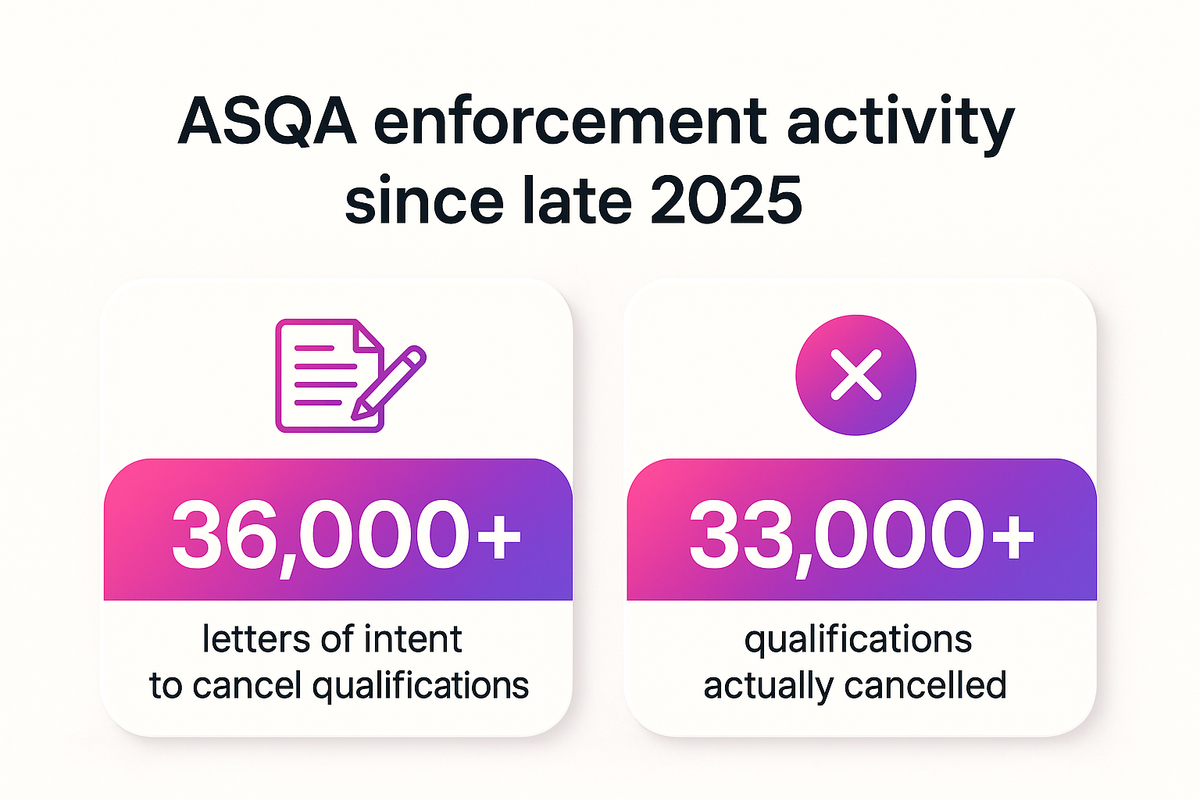
The enforcement numbers back this up. Since late 2025, more than 36,000 students have received letters of intent to cancel their qualifications, with over 33,000 cancellations already executed. At least one provider, Melbourne Training Centre (trading as Studywise College), had its registration cancelled in 2025 over inadequate assessment practices. None of these outcomes start with a bad training delivery decision — they start with weak evidence and processes that don't hold up under scrutiny.
The clock on batch reporting is already ticking
The bigger structural shift is the VET Data Streamlining Program, expected to launch a new VET Information Standard from mid-2026, moving the sector to API-based reporting technology. Full transition away from the current batch, file-based NAT submission model is mandatory by January 2029.
That date isn't far off in operational terms. If your student management system and your delivery, assessment and enrolment records aren't already talking to each other cleanly, the annual scramble you run today becomes a much bigger integration project under time pressure later. RTOs that start treating data cleanliness as continuous now are simply doing the 2029 transition early, in manageable pieces.
The systems question only you can answer
Current guidance for RTOs choosing a student management system frames the core operational decision plainly: a single integrated system, or multiple systems stitched together with integrations between them. Either can work. What doesn't work is pretending the choice isn't yours to make, or leaving it as an accumulation of point solutions nobody owns end to end.
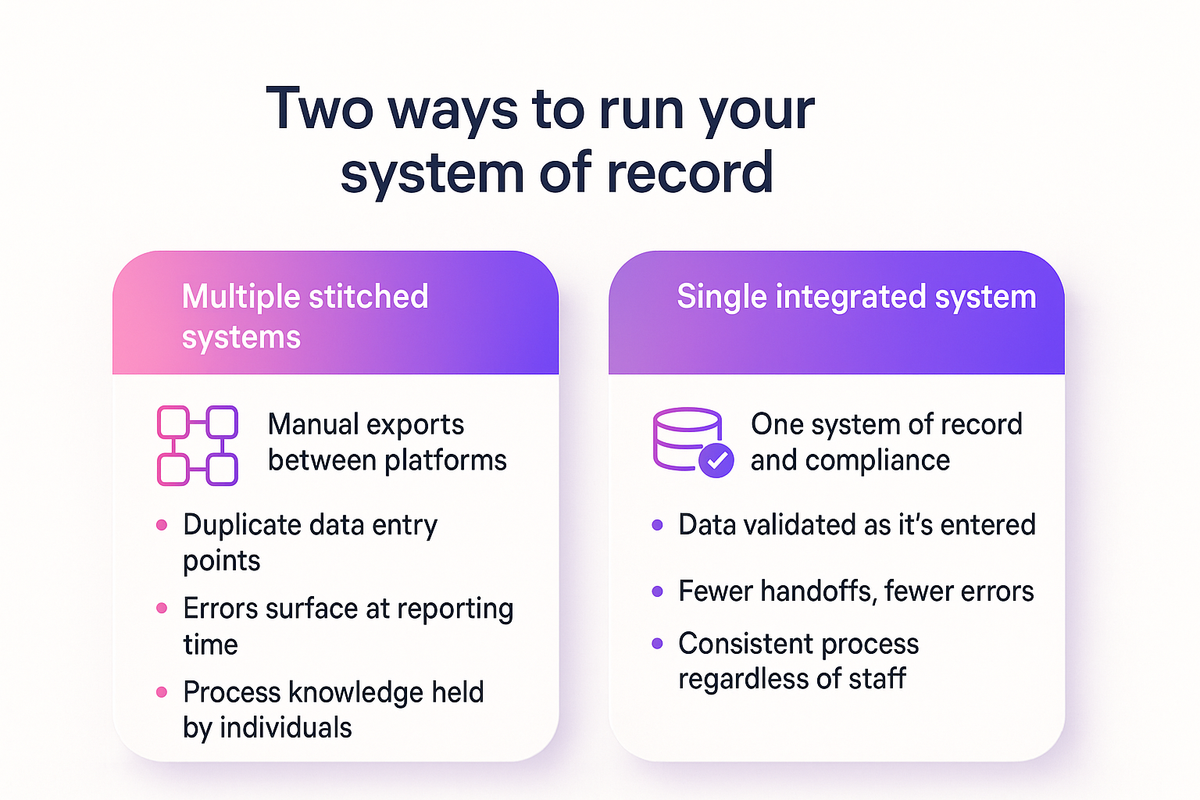
Your SMS is now, functionally, both your system of record and your system of compliance. Every duplicate data entry point, every manual export-import between platforms, every process that only one staff member fully understands, is a place where AVETMISS errors are quietly born months before anyone goes looking for them.
Key takeaways
- Fee-for-service RTOs must submit 2025 AVETMISS data to NCVER by 5pm ACDT, 28 February 2026 — but the deadline isn't the real cost; the cleansing sprint before it is.
- NCVER's optional quarterly reporting windows exist specifically to catch validation errors year-round, turning the annual submission into a formality rather than a crisis.
- The Standards for RTOs 2025 and the Annual Declaration on Compliance now require evidence that systems function correctly in practice, not just documentation on file — an operational deliverable as much as a compliance one.
- The VET Data Streamlining Program will move the sector to API-based reporting, mandatory by January 2029, retiring the batch NAT-file model the annual crunch relies on.
- ASQA's enforcement activity, and its own sector research showing governance as providers' weakest area, both point to process and evidence gaps — not delivery quality — as the higher-risk problem.
Our take
The RTOs that keep treating AVETMISS as an annual fire drill aren't being lazy — they're optimising for the wrong constraint. The NCVER deadline is fixed and known well in advance; the real variable is whether your enrolment, assessment and outcomes data stays clean as it's created, or accumulates errors that someone has to hunt down later. Quarterly reporting windows already let you test that discipline four times a year, for free, well before the 2029 API deadline forces the issue. If your team can't confidently answer 'is our data clean right now' without opening a spreadsheet, that's the gap worth closing this quarter — not next February.
FAQ
What's the actual AVETMISS deadline for 2026 reporting? RTOs that delivered fee-for-service training in 2025 must submit AVETMISS data to NCVER by 5pm ACDT on 28 February 2026.
Do quarterly reporting windows replace the annual AVETMISS submission? No. They're optional interim windows — opening four weeks after each quarter and open for roughly two weeks — designed to catch validation errors early so the annual submission is less onerous, not a replacement for it.
What does the Annual Declaration on Compliance actually require operationally? ASQA emails each RTO's CEO a unique weblink to complete the declaration; the 2026 window closed 31 March 2026. It requires attestation that your systems operate as documented in practice, in line with the Standards for RTOs 2025, not just that policies exist on paper.
When does API-based AVETMISS reporting become mandatory? The VET Data Streamlining Program is expected to introduce a new VET Information Standard and API-based reporting from mid-2026, with full transition away from the current batch, file-based NAT submission model mandatory by January 2029.