ASQA Turns AI Use Into a Standards for RTOs 2025 Issue
30 July 2026 · 6 min read

ASQA has stopped treating artificial intelligence as a side conversation. Its new AI guidance page, a set of draft AI Principles, and a 2026 Sector Workshop Series built around one direct question — is your RTO's use of AI compliant with the Standards for RTOs 2025 — signal that AI-assisted assessment and training material development is now something auditors will test, not just something providers explain if asked.
What actually changed
ASQA's guidance page sits inside its 'Guidance and resources for providers' hub — the same hub that helps RTOs meet obligations under the VET Quality Framework and the National Vocational Education and Training Regulator Act 2011. That placement matters. It's a deliberate signal that AI use by training providers is a compliance matter, distinct from ASQA's own AI Transparency Statement, which only covers how the regulator uses AI internally.
The regulator is also drafting AI Principles. These won't create new legislation. Instead, they tie AI use back into obligations RTOs already carry under the Standards for RTOs 2025 — assessment design, academic integrity, learner protection, staff capability, governance and self-assurance. In other words, nothing new is being invented; what's new is that AI is now explicitly named inside frameworks providers already have to satisfy.
Why the 2026 workshops raise the stakes
ASQA's 2026 Sector Workshop Series is framed around a compliance question, not a technology briefing. That framing tells providers the regulator expects a demonstrable answer, not a general assurance that "we use AI carefully."
The practical shift:
- AI in assessment or resource development moves from a productivity choice to something auditors can ask about directly.
- ASQA has named provider-enabled dishonesty as a risk category — meaning the concern isn't only students misusing AI, it's RTOs generating assessments or learning content via AI without documented human validation.
- That risk exists regardless of intent. An RTO that used AI well but can't show its evidence trail is exposed at audit the same as one that used it carelessly.
Where AI-generated content gets scrutinised
Sector commentary on this shift describes it as turning AI from a digital capability issue into a standards issue. That lands directly on three things ASQA auditors already scrutinise during validation:
- Assessment quality — does the assessment actually test the required knowledge and performance evidence?
- Coverage mapping — does the assessment map cleanly back to the unit of competency, including all elements and performance criteria?
- Evidence integrity — can the RTO show, on demand, how the assessment was produced, checked and approved before it reached a learner?
AI doesn't change what auditors look for here. It changes what providers need to be able to prove about how the content was made.
What RTOs need in place before the workshops
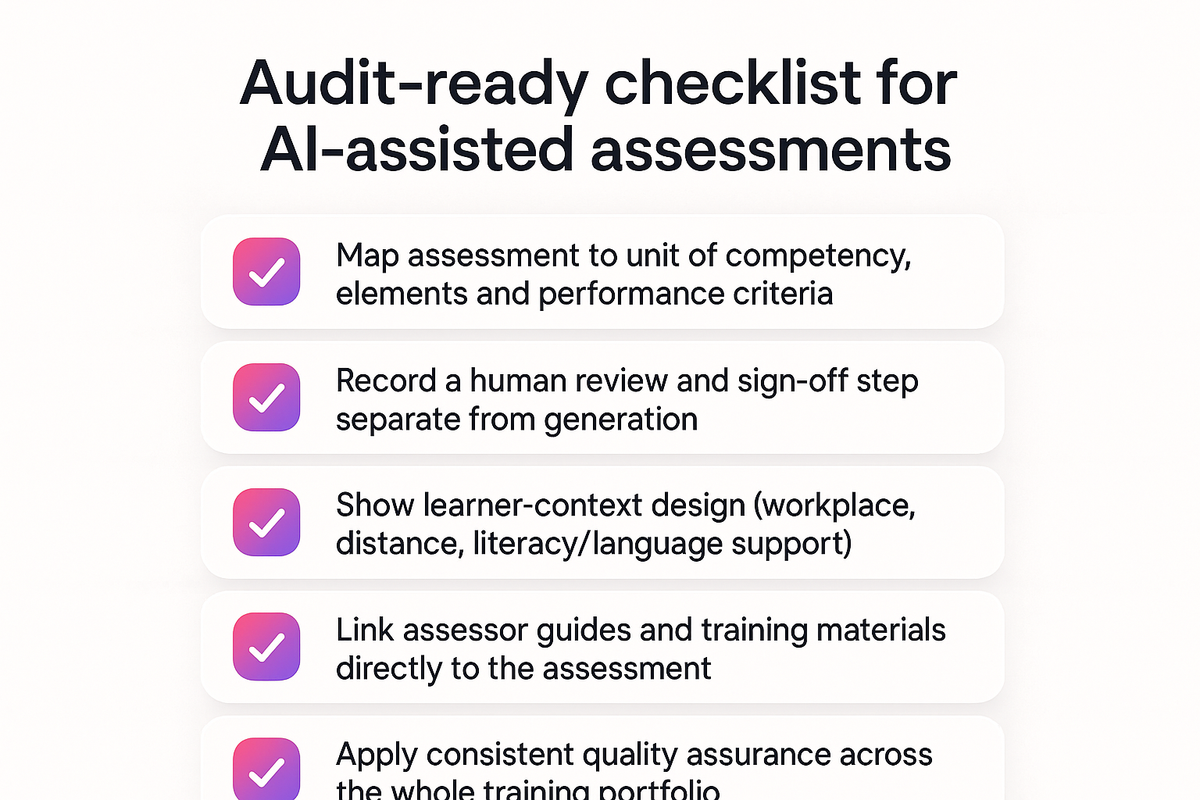
For training organisations already generating assessments or training packages content faster with AI tools, the compliance bar isn't speed — it's traceability. Practically, that means every AI-assisted assessment or resource should carry:
- A documented mapping trail back to the specific unit of competency, elements and performance criteria it addresses.
- A recorded human review and sign-off step, separate from the AI generation step.
- Evidence of context-appropriate design for the learners it's built for — workplace-based, distance, or learners with additional literacy or language support needs.
- Assessor guides and training materials that are demonstrably linked to the assessment they support, not developed in isolation.
- A quality assurance process applied consistently across the training portfolio, not ad hoc per unit.
None of this is exotic. It's the same rigour RTOs have always needed for manually developed assessments. What's changed is that AI-generated content no longer gets a pass simply because it was produced quickly — it needs the same audit-ready paper trail, and ASQA has now said so explicitly.
Key takeaways
- ASQA's AI guidance page places AI use for RTOs inside its compliance hub, separate from its own internal AI Transparency Statement.
- Draft AI Principles will map AI use onto existing Standards for RTOs 2025 obligations — no new legislation, but explicit new scrutiny.
- ASQA's 2026 Sector Workshop Series is built around testing AI compliance directly, not explaining AI options.
- Provider-enabled dishonesty — AI-generated content without documented human validation — is now a named audit risk.
- Audit-readiness for AI-assisted assessment means demonstrable unit of competency mapping plus a recorded human review step, every time.
Our take
This shift was predictable, and honestly, overdue. Any regulator watching a sector rapidly adopt generative tools for assessment and training material development was always going to ask for evidence, not assurances. The RTOs that find this transition painless will be the ones that already treat AI output as a draft requiring sign-off, not a finished product — because mapping and human validation aren't new compliance burdens, they're the same discipline ASQA has always expected of manually written assessments. The RTOs that struggle will be those that saved time on generation but never built the audit trail behind it.
FAQ
Does ASQA ban AI use in assessment or training material development? No. ASQA's guidance doesn't prohibit AI use. It frames AI-assisted assessment and resource development as something that must comply with the Standards for RTOs 2025, meaning it needs the same mapping, validation and evidence trail as any other assessment method.
What is 'provider-enabled dishonesty' in ASQA's framing? It's a risk category ASQA has named alongside student misuse of AI, referring to RTOs producing assessments or training content via AI without documented human validation — regardless of whether the outcome was actually poor quality.
What are ASQA's draft AI Principles expected to cover? Based on ASQA's guidance, the draft AI Principles are expected to address assessment design, academic integrity, learner protection, staff capability, governance and self-assurance — all tied back to existing Standards for RTOs 2025 obligations rather than new legislation.
What should an RTO have ready before the 2026 ASQA sector workshops? A documented mapping trail linking AI-assisted assessments to the relevant unit of competency, a recorded human review and sign-off step, and evidence that quality assurance is applied consistently across the training portfolio.
Where can RTOs find ASQA's official guidance on AI in VET? ASQA's guidance sits within its 'Guidance and resources for providers' hub, available at asqa.gov.au, alongside broader resources on the VET Quality Framework and the Standards for RTOs 2025.